
Tim Berners-Lee was born in London in 1955. From a young age, he showed a keen interest in computers and technology. He studied physics at Oxford University, although his true passion lay in electronics and programming.
After graduating, he worked as a software engineer across diverse projects, constantly thinking about how to connect information globally. He envisioned a decentralized system where people could share documents and links effortlessly, a concept he referred to as a “web” of information.
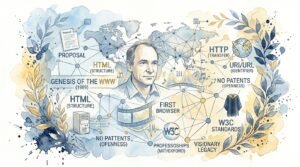
In 1989, while working at CERN (the European Organization for Nuclear Research), he submitted a proposal for a new information management system. His manager, Mike Sendall, famously annotated the proposal as “vague but exciting.” Although his initial proposal on March 12, 1989, gained limited traction, it marked the genesis of the World Wide Web.
By 1990, Berners-Lee had developed the first web browser and editor, named “WorldWideWeb.” He also implemented the first web server and the first webpages, establishing the foundational protocols of the modern internet: HTML (HyperText Markup Language), URI/URL (Uniform Resource Identifier), and HTTP (HyperText Transfer Protocol). These breakthroughs enabled heterogeneous computer networks to communicate seamlessly.
Berners-Lee chose not to patent his invention, ensuring the World Wide Web remained a royalty-free and open platform for all humanity rather than a commercial product.
Since 1994, he has served as the director of the World Wide Web Consortium (W3C), an organization dedicated to maintaining open web standards. In addition, he holds professorships at MIT and Oxford University. Tim Berners-Lee stands as a true visionary who not only engineered a transformative technology, but also revolutionized the way humanity communicates, learns, and collaborates.